Blog
Hall‑Effect vs. TMR: What Electromagnetic Joysticks Mean for Your Gamepad


Potentiometer vs. Hall Effect vs. TMR Joysticks
Modern controllers can use three main types of joystick-position sensing: traditional potentiometers, Hall-effect sensors, and TMR sensors. Each technology measures movement differently, and the sensor is only one part of the joystick. Springs, pivots, magnets, calibration, firmware, and controller electronics also affect accuracy, centering, dead zones, and overall feel.
| Technology | How It Works | Main Advantages | Important Limitations |
|---|---|---|---|
| Potentiometer | A mechanical wiper moves across a resistive track. The changing resistance is converted into stick position. | Affordable, widely supported, and proven | The resistive track and wiper can wear or become contaminated, eventually causing drift, dead zones, or inconsistent movement |
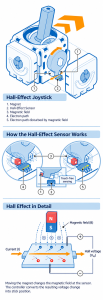
| Hall Effect | A magnet moves with the joystick while a Hall-effect sensor measures changes in the magnetic field and produces a corresponding electrical signal. | Contactless position sensing, no resistive-track wear, smooth output, and broad aftermarket availability | Can require careful magnet alignment and calibration; performance and power consumption vary by module |
| TMR | A tunneling magnetoresistance sensor detects magnetic-field changes through corresponding changes in electrical resistance. | Contactless sensing, high magnetic sensitivity, low power consumption, and increasingly broad controller support | Usually costs more than basic potentiometer or Hall-effect modules, and results still depend on module quality, installation, and firmware |
Feature-by-Feature Comparison
1. Precision and Resolution
Hall Effect: Hall-effect joysticks can provide smooth and precise position sensing, but their usable resolution depends on the sensor, analog-to-digital converter, controller firmware, calibration, and USB or wireless implementation.
TMR: TMR sensors generally provide greater magnetic sensitivity and can support highly detailed position measurements. However, a TMR sensor does not automatically make the entire controller more accurate. Firmware filtering, calibration, dead-zone settings, and mechanical quality remain equally important.
Bottom line: Claims such as “300 points versus 3,000 points” should not be treated as universal specifications. Those numbers can describe particular products or test methods, but they do not apply to every Hall-effect or TMR joystick.
2. Polling Rate and Responsiveness
The joystick sensor does not determine the controller’s polling rate by itself. Polling rate is controlled primarily by the controller’s processor, firmware, USB or wireless interface, and communication protocol.
A fast TMR sensor may give the controller electronics more frequent or cleaner measurements, but installing TMR modules does not automatically turn a 1,000 Hz controller into a 20,000 Hz controller. Actual input latency must be evaluated at the complete-controller level.
3. Power Consumption
TMR joystick sensors are generally more power-efficient than linear Hall-effect sensors. Current production modules commonly place individual TMR sensors in roughly the 0.1–0.3 mA range, while comparable linear Hall sensors may consume approximately 0.5–2 mA.
This difference can be useful in wireless controllers, but the joysticks are only one part of the controller’s total power consumption. Bluetooth, lighting, vibration motors, speakers, processors, and other electronics may have a much larger effect on battery life.
4. Drift and Durability
Hall-effect and TMR joysticks eliminate the resistive-track wear that commonly causes potentiometer drift. That gives both technologies a major durability advantage.
However, neither technology guarantees that a controller will remain permanently drift-free. Drift or poor centering can still result from worn springs, loose mechanical parts, magnet movement, contamination, temperature changes, improper installation, calibration errors, or firmware behavior.
A more accurate description is that Hall-effect and TMR sensors are resistant to potentiometer-related drift rather than completely immune to every form of drift.
5. Dead Zones and Centering
TMR’s higher magnetic sensitivity may allow a manufacturer to use smaller dead zones, but the final dead-zone behavior is determined by firmware and calibration. A poorly calibrated TMR module can perform worse than a well-designed Hall-effect or potentiometer joystick.
For replacement modules, proper installation and calibration are essential. Some controllers can be calibrated through software, while others may require manual centering, circuit adjustments, or specialized calibration tools.
6. Triggers and Other Controls
Hall-effect sensors are already widely used in contactless analog triggers. TMR sensors can perform similar magnetic-position sensing while potentially using less power, but availability depends on the controller and replacement-module design.
In either case, contactless sensing removes wear at the electrical sensing surface. It does not eliminate wear in the trigger spring, hinge, or other moving components.
7. Replacement Modules and Modifications
Hall Effect: Hall-effect replacement modules are available for many PlayStation, Xbox, Nintendo, and third-party controllers. Compatibility, calibration requirements, and module quality can vary considerably.
TMR: TMR is no longer merely an experimental or early-stage option. TMR replacement modules and complete third-party controllers are now available for several major platforms. Even so, buyers should confirm the exact controller revision and calibration procedure before ordering.
Which Technology Is Best?
- For inexpensive original-style repairs: A quality potentiometer module may still be the most practical choice.
- For avoiding resistive-track wear: Both Hall-effect and TMR joysticks provide contactless position sensing.
- For lower sensor power consumption: TMR generally has the advantage over linear Hall-effect sensors.
- For the best real-world performance: Judge the complete controller or module—not the sensor name alone.
- For replacement installations: Compatibility and proper calibration matter more than marketing claims.
What TMR Does—and Does Not—Improve
TMR technology can provide excellent sensitivity, low power consumption, and freedom from resistive-track wear. Those are meaningful improvements, especially for wireless controllers and long-term durability.
It does not automatically reduce the physical force needed to move the stick because that force is determined primarily by the joystick’s springs and mechanical construction. It also does not automatically increase USB polling rate, eliminate every possible cause of drift, or guarantee lower latency.
The Road Ahead
TMR joystick technology has moved beyond the prototype stage. Replacement modules and complete TMR-equipped controllers are already available, and adoption continues to expand.
Hall-effect joysticks remain a strong and well-established contactless option. TMR improves on several sensor-level characteristics—particularly magnetic sensitivity and power consumption—but the quality of the complete joystick assembly, calibration, and controller firmware ultimately determines how well it performs.
Frequently Asked Questions
What is the difference between Hall effect and TMR?
Both technologies use magnets and provide contactless position sensing. A Hall-effect sensor produces a voltage in response to a magnetic field, while a TMR sensor changes electrical resistance as the magnetic field changes.
Are TMR joysticks completely drift-proof?
No joystick is completely immune to every possible centering problem. TMR eliminates resistive-track wear, but springs, pivots, magnets, calibration, installation, and firmware can still cause drift-like behavior.
Does TMR automatically improve polling rate?
No. Polling rate is primarily controlled by the controller’s processor, firmware, and communication interface. A TMR sensor can provide fast measurements, but the complete controller determines how often those measurements are reported.
Will TMR make the joystick easier to move?
Not by itself. Stick tension and required movement force are determined mainly by the mechanical spring and joystick assembly.
Is TMR always better than Hall effect?
Not necessarily. TMR generally offers lower sensor power consumption and high magnetic sensitivity, but a well-designed Hall-effect controller can outperform a poorly designed or improperly calibrated TMR controller.
Have questions about joystick drift, Hall-effect upgrades, TMR modules, or controller calibration? Contact Trílex Fix and we’ll help you determine the best repair or upgrade for your controller.